If you're looking for our new GCSE Media specification blogs, use the links below!
GCSE Media Year 1: https://mediamacguffingcseyear1.blogspot.com/
GCSE Media Year 2: https://mediamacguffingcseyear2.blogspot.com/
Friday, September 7, 2018

Thursday, May 10, 2018
Task 1 Revision clips and questions
You need to know very detailed information about existing TV dramas for Task 1 of the exam.
The following clips and questions will help with your preparation for this crucial task.
Research & Revision
Stranger Things
1) Watch the whole of the opening 8 minutes of Stranger Things. (If you have Netflix at home, watch the rest of episode 1.)
2) Read this Stranger Things Wikipedia entry to get some background to the show. How many seasons and episodes have there been? How long is each episode?
3) How does Stranger Things meet the conventions of TV drama: ensemble cast? Stock characters? Story arcs? Episodic narratives? Enigma and tension? Realism?
4) What would be the sub-genre of TV drama that Stranger Things best fits into?
5) What audience pleasures are provided by Stranger Things? Why do audiences love it? Use media theory here - Uses & Gratifications theory and the 3 Vs.
6) What unusual or particularly effective marketing techniques have been employed by Stranger Things and Netflix to generate interest in the show?
Waterloo Road
1) Watch the whole of Waterloo Road - Season 1, Episode 1:
2) Re-read this Waterloo Road Wikipedia entry and write down the number of seasons and episodes broadcast and the channels they have appeared on.
3) How does Waterloo Road meet the key conventions of TV Drama: ensemble cast? Stock characters? Story arcs? Episodic narratives? Enigma and tension? Realism?
4) Write down three storylines (or narratives) from Waterloo Road - note which season the storyline appeared in. They can be from the first episode above or from the clips below:
5) Why might audiences have enjoyed Waterloo Road?
Doctor Who
1) Re-watch these extracts from the classic Doctor Who episode 'Blink' when the Doctor was played by David Tennant during series' 2-4:
2) Read the opening of this Wikipedia entry for Doctor Who and make notes on why the show is so popular.
3) Now read this Wikipedia entry for the episode above - 'Blink'. Why is 'Blink' considered to be one of the best Doctor Who episodes ever?
3) List the key conventions of TV Drama that you can find in Doctor Who.
4) Write down three storylines (or narratives) that have moments of Enigma or tension - note which season the storyline appeared in. They can be from the earlier episodes (such as 'Blink' above) or from the Matt Smith series 6 that we have watched this week.
The following clips are from Doctor Who - The Impossible Astronaut:
5) What audience pleasures are provided by Doctor Who?
The following clips and questions will help with your preparation for this crucial task.
Research & Revision
Stranger Things
1) Watch the whole of the opening 8 minutes of Stranger Things. (If you have Netflix at home, watch the rest of episode 1.)
2) Read this Stranger Things Wikipedia entry to get some background to the show. How many seasons and episodes have there been? How long is each episode?
3) How does Stranger Things meet the conventions of TV drama: ensemble cast? Stock characters? Story arcs? Episodic narratives? Enigma and tension? Realism?
4) What would be the sub-genre of TV drama that Stranger Things best fits into?
5) What audience pleasures are provided by Stranger Things? Why do audiences love it? Use media theory here - Uses & Gratifications theory and the 3 Vs.
6) What unusual or particularly effective marketing techniques have been employed by Stranger Things and Netflix to generate interest in the show?
Waterloo Road
1) Watch the whole of Waterloo Road - Season 1, Episode 1:
2) Re-read this Waterloo Road Wikipedia entry and write down the number of seasons and episodes broadcast and the channels they have appeared on.
3) How does Waterloo Road meet the key conventions of TV Drama: ensemble cast? Stock characters? Story arcs? Episodic narratives? Enigma and tension? Realism?
4) Write down three storylines (or narratives) from Waterloo Road - note which season the storyline appeared in. They can be from the first episode above or from the clips below:
- Lenny's Dilemma Series 10
- Justin Snaps Series 10
- There are clips from all series' of Waterloo Road also available here: Waterloo Road all clips
5) Why might audiences have enjoyed Waterloo Road?
Doctor Who
1) Re-watch these extracts from the classic Doctor Who episode 'Blink' when the Doctor was played by David Tennant during series' 2-4:
2) Read the opening of this Wikipedia entry for Doctor Who and make notes on why the show is so popular.
3) Now read this Wikipedia entry for the episode above - 'Blink'. Why is 'Blink' considered to be one of the best Doctor Who episodes ever?
3) List the key conventions of TV Drama that you can find in Doctor Who.
4) Write down three storylines (or narratives) that have moments of Enigma or tension - note which season the storyline appeared in. They can be from the earlier episodes (such as 'Blink' above) or from the Matt Smith series 6 that we have watched this week.
The following clips are from Doctor Who - The Impossible Astronaut:
5) What audience pleasures are provided by Doctor Who?
Revision pack and useful links
Ms Fowler has created a range of excellent resources to help prepare you for this exam. Use the following to help you:
Revision pack
Use this revision pack at home or in Study Club to help prepare for the upcoming PPE. It has brilliant tips on how to approach each question and what you need to create and revise before the exam.
Guidance on exam structure
This blogpost on exam structure will remind you of what each task could involve and the different things you need to prepare for.
Example Task 1 paragraph for Stranger Things
This example of how to structure a Task 1 answer is useful in terms of what the examiner is expecting in the exam.
CEEA paragraph structure
If you're not sure on the CEEA paragraph structure you can get an introduction to it here.
Ms Fowler has created a range of excellent resources to help prepare you for this exam. Use the following to help you:
Revision pack
Use this revision pack at home or in Study Club to help prepare for the upcoming PPE. It has brilliant tips on how to approach each question and what you need to create and revise before the exam.
Guidance on exam structure
This blogpost on exam structure will remind you of what each task could involve and the different things you need to prepare for.
Example Task 1 paragraph for Stranger Things
This example of how to structure a Task 1 answer is useful in terms of what the examiner is expecting in the exam.
CEEA paragraph structure
If you're not sure on the CEEA paragraph structure you can get an introduction to it here.
Thursday, May 3, 2018
Institution: Public service broadcasting
Public service broadcasting is an important aspect of the institution key concept for TV drama.
Public service broadcasting refers to TV channels that are designed for public benefit rather than just to make money.
The media regulator Ofcom requires certain TV and radio broadcasters to show certain programming as part of their license e.g news, documentary, sport etc.
All of the BBC's television and radio stations have a public service remit. Indeed, the BBC is the best example of public service broadcasting. It was set up in 1922 with a famous mission statement it retains to this day:
Doctor Who is the perfect fit for BBC1 as it is a long-running, much-loved mainstream series aimed at a family audience. It has been running for over 50 years and is considered a national treasure in the UK. It is generally quite innocent, family-friendly and features highly regarded British actors.
Public service broadcasting refers to TV channels that are designed for public benefit rather than just to make money.
The media regulator Ofcom requires certain TV and radio broadcasters to show certain programming as part of their license e.g news, documentary, sport etc.
All of the BBC's television and radio stations have a public service remit. Indeed, the BBC is the best example of public service broadcasting. It was set up in 1922 with a famous mission statement it retains to this day:
“To inform, educate and entertain.”
The license fee
All BBC content (and some of Channel 4’s funding) is paid for by the License Fee, which costs £147 a year.
You need a TV Licence to:
- watch or record live TV programmes on any channel
- download or watch any BBC programmes on iPlayer – live, catch up or on demand.
Some politicians want to scrap the license fee and change the BBC’s funding model.
Public service broadcasting: blog task
Complete the following tasks on TV drama and institution:
1) What is the difference between public service broadcasting and commercial broadcasting?
2) What type of TV programme does each of the following channels usually offer:
BBC1
BBC2
ITV1
ITV2
Channel 4
Channel 5
3) Choose three of the channels above and find a TV drama that is broadcast on that channel that you feel represents the type of channel it is. Embed a clip or trailer in your blog and explain why it fits the channel it is broadcast on.
Example: BBC1
Doctor Who is the perfect fit for BBC1 as it is a long-running, much-loved mainstream series aimed at a family audience. It has been running for over 50 years and is considered a national treasure in the UK. It is generally quite innocent, family-friendly and features highly regarded British actors.
Make sure you've also completed the last work on institution - Netflix and the impact of new/digital media on TV.
Monday, March 26, 2018
FINAL TV drama PPE - April 2018
Your FINAL Media Studies PPE will be taken in class when you come back from the Easter holidays.
You will have received a copy of the preliminary brief in class.
You MUST complete OR revise the following research and planning tasks before the exam after Easter.
Research & Revision
Stranger Things
1) Watch the whole of the opening 8 minutes of Stranger Things. (If you have Netflix at home, watch the rest of episode 1.)
2) Read this Stranger Things Wikipedia entry to get some background to the show. How many seasons and episodes have there been? How long is each episode?
3) How does Stranger Things meet the conventions of TV drama: ensemble cast? Stock characters? Story arcs? Episodic narratives? Enigma and tension? Realism?
4) What would be the sub-genre of TV drama that Stranger Things best fits into?
5) What audience pleasures are provided by Stranger Things? Why do audiences love it? Use media theory here - Uses & Gratifications theory and the 3 Vs.
6) What unusual or particularly effective marketing techniques have been employed by Stranger Things and Netflix to generate interest in the show?
Waterloo Road
1) Watch the whole of Waterloo Road - Season 1, Episode 1:
2) Re-read this Waterloo Road Wikipedia entry and write down the number of seasons and episodes broadcast and the channels they have appeared on.
3) How does Waterloo Road meet the key conventions of TV Drama: ensemble cast? Stock characters? Story arcs? Episodic narratives? Enigma and tension? Realism?
4) Write down three storylines (or narratives) from Waterloo Road - note which season the storyline appeared in. They can be from the first episode above or from the clips below:
5) Why might audiences have enjoyed Waterloo Road?
Doctor Who
1) Re-watch these extracts from the classic Doctor Who episode 'Blink' when the Doctor was played by David Tennant during series' 2-4:
2) Read the opening of this Wikipedia entry for Doctor Who and make notes on why the show is so popular.
3) Now read this Wikipedia entry for the episode above - 'Blink'. Why is 'Blink' considered to be one of the best Doctor Who episodes ever?
3) List the key conventions of TV Drama that you can find in Doctor Who.
4) Write down three storylines (or narratives) that have moments of Enigma or tension - note which season the storyline appeared in. They can be from the earlier episodes (such as 'Blink' above) or from the Matt Smith series 6 that we have watched this week.
The following clips are from Doctor Who - The Impossible Astronaut:
5) What audience pleasures are provided by Doctor Who?
Planning: BLUESKY PRODUCTIONS
Complete the following planning tasks to ensure you are prepared for the BLUESKY PRODUCTIONS brief.
1) Brainstorm ideas for a new TV Drama for a mainstream audience demographic using one of the three TV drama sub-genres provided on the brief. Plan out the following:
3) Storyboard the opening (length: 30 seconds) of your new TV Drama. Use this AQA storyboard sheet if you don't pick up a paper copy in class.
4) Storyboard a 30 second advert or trailer for your chosen TV drama idea. Use the storyboard link above.
5) Come up with a variety of ways to promote your new TV Drama to your target audience. Plan out the following:
You will have received a copy of the preliminary brief in class.
You MUST complete OR revise the following research and planning tasks before the exam after Easter.
Research & Revision
Stranger Things
1) Watch the whole of the opening 8 minutes of Stranger Things. (If you have Netflix at home, watch the rest of episode 1.)
2) Read this Stranger Things Wikipedia entry to get some background to the show. How many seasons and episodes have there been? How long is each episode?
3) How does Stranger Things meet the conventions of TV drama: ensemble cast? Stock characters? Story arcs? Episodic narratives? Enigma and tension? Realism?
4) What would be the sub-genre of TV drama that Stranger Things best fits into?
5) What audience pleasures are provided by Stranger Things? Why do audiences love it? Use media theory here - Uses & Gratifications theory and the 3 Vs.
6) What unusual or particularly effective marketing techniques have been employed by Stranger Things and Netflix to generate interest in the show?
Waterloo Road
1) Watch the whole of Waterloo Road - Season 1, Episode 1:
2) Re-read this Waterloo Road Wikipedia entry and write down the number of seasons and episodes broadcast and the channels they have appeared on.
3) How does Waterloo Road meet the key conventions of TV Drama: ensemble cast? Stock characters? Story arcs? Episodic narratives? Enigma and tension? Realism?
4) Write down three storylines (or narratives) from Waterloo Road - note which season the storyline appeared in. They can be from the first episode above or from the clips below:
- Lenny's Dilemma Series 10
- Justin Snaps Series 10
- There are clips from all series' of Waterloo Road also available here: Waterloo Road all clips
5) Why might audiences have enjoyed Waterloo Road?
Doctor Who
1) Re-watch these extracts from the classic Doctor Who episode 'Blink' when the Doctor was played by David Tennant during series' 2-4:
2) Read the opening of this Wikipedia entry for Doctor Who and make notes on why the show is so popular.
3) Now read this Wikipedia entry for the episode above - 'Blink'. Why is 'Blink' considered to be one of the best Doctor Who episodes ever?
3) List the key conventions of TV Drama that you can find in Doctor Who.
4) Write down three storylines (or narratives) that have moments of Enigma or tension - note which season the storyline appeared in. They can be from the earlier episodes (such as 'Blink' above) or from the Matt Smith series 6 that we have watched this week.
The following clips are from Doctor Who - The Impossible Astronaut:
5) What audience pleasures are provided by Doctor Who?
Planning: BLUESKY PRODUCTIONS
Complete the following planning tasks to ensure you are prepared for the BLUESKY PRODUCTIONS brief.
1) Brainstorm ideas for a new TV Drama for a mainstream audience demographic using one of the three TV drama sub-genres provided on the brief. Plan out the following:
- Sub-genre - which one of the three are you choosing?
- Title and tagline - how will you sell the drama to an audience?
- Format - how many episodes? How long is each episode? What channel will it appear on and why (remember the brief - 8pm - 9pm slot)?
- Setting - how will you use the setting provided in the brief?
- Main characters and why audiences will like/dislike them. Note that you need a balance between male and female characters.
- A minimum of three narratives or storylines - at least one should cover the series arc (a narrative that continues across the whole series) and one should be resolved within an episode (episodic narrative).
- Your TV drama's USP - unique selling point
- Your show's detailed target audience (demographics and similar shows they might watch). Remember: the audience specified by the preliminary brief is a mainstream audience - but how are you interpreting that?
- Three reasons your TV drama will appeal to that target audience.
- Three audience pleasures that your TV drama will provide - using media theory (Uses & Gratifications; 3 Vs etc.)
3) Storyboard the opening (length: 30 seconds) of your new TV Drama. Use this AQA storyboard sheet if you don't pick up a paper copy in class.
4) Storyboard a 30 second advert or trailer for your chosen TV drama idea. Use the storyboard link above.
5) Come up with a variety of ways to promote your new TV Drama to your target audience. Plan out the following:
- Official website for the TV drama that allows audiences to meet the characters and find out more about the storylines.
- Ideas to feature your drama on social media e.g. hashtag, video content, Instagram filters, Twitter feeds etc.
- Any other creative or unusual ways to promote your new TV drama to the audience.
6) Write a three-paragraph answer for why your new TV drama will be successful in the incredibly competitive marketplace of modern television.
Revision pack and useful links
Ms Fowler has created a range of excellent resources to help prepare you for this exam. Use the following to help you:
Revision pack
Use this revision pack at home or in Study Club to help prepare for the upcoming PPE. It has brilliant tips on how to approach each question and what you need to create and revise before the exam.
Guidance on exam structure
This blogpost on exam structure will remind you of what each task could involve and the different things you need to prepare for.
Example Task 1 paragraph for Stranger Things
This example of how to structure a Task 1 answer is useful in terms of what the examiner is expecting in the exam.
CEEA paragraph structure
If you're not sure on the CEEA paragraph structure you can get an introduction to it here.
All tasks MUST be completed for Thursday 19 April for the final mock exam.
Revision pack and useful links
Ms Fowler has created a range of excellent resources to help prepare you for this exam. Use the following to help you:
Revision pack
Use this revision pack at home or in Study Club to help prepare for the upcoming PPE. It has brilliant tips on how to approach each question and what you need to create and revise before the exam.
Guidance on exam structure
This blogpost on exam structure will remind you of what each task could involve and the different things you need to prepare for.
Example Task 1 paragraph for Stranger Things
This example of how to structure a Task 1 answer is useful in terms of what the examiner is expecting in the exam.
CEEA paragraph structure
If you're not sure on the CEEA paragraph structure you can get an introduction to it here.
Wednesday, March 21, 2018
Institution: the impact of digital media on TV Drama
The internet has had a huge impact on the television industry in the last 10 years.
Streaming services like Netflix and Amazon Prime have fundamentally changed the way we watch television. In just 10 years, Netflix has gone from a mail-order DVD company to a giant in the television industry. Next year, Netflix plans to spend $8 BILLION making original TV programmes.
TV Drama
One of the key genres for Netflix and Amazon Prime is serial television drama. Many of these dramas now have the budgets and production values of Hollywood movies and many top actors are choosing to work in television rather than film.
For audiences, streaming has changed the way we watch television. 'Event TV', when millions of people around the country would tune in to watch the latest episode of a drama at a set time, is far less important now. Many people now 'binge-watch' TV dramas by watching several episodes back-to-back.
Digital media and television: blog task
Read the Media Magazine article on Netflix and the Cultural Industries (MM63 - page 45). Our Media Magazine archive is here - this is aimed at A Level Media students but this article will give you a brilliant introduction to the kind of ideas you'll explore if you continue Media Studies in sixth form. It also looks at the internet, Netflix, Amazon Prime and Stranger Things - so perfect for our exam topic.
Read the article and answer the following questions:
1) What has been the biggest change in media industries in the last 30 years?
2) How did Amazon and Netflix begin before they were streaming TV services?
3) How much does Netflix and Amazon plan to spend on making original TV material next year?
4) What other companies have recently joined the digital TV market (or are thinking of doing so)?
5) How many countries are Netflix and Amazon available in?
6) What did Netflix do to make sure Stranger Things would translate easily into other languages?
7) How has the internet changed the way we watch television?
8) Do you think streaming services such as Netflix and Amazon Prime have improved television for audiences or has quality gone down?
You should consider these institutional factors when responding to your next exam brief - discussing these kinds of issues and audience habits will demonstrate you are a top-level student.
Streaming services like Netflix and Amazon Prime have fundamentally changed the way we watch television. In just 10 years, Netflix has gone from a mail-order DVD company to a giant in the television industry. Next year, Netflix plans to spend $8 BILLION making original TV programmes.
TV Drama
One of the key genres for Netflix and Amazon Prime is serial television drama. Many of these dramas now have the budgets and production values of Hollywood movies and many top actors are choosing to work in television rather than film.
For audiences, streaming has changed the way we watch television. 'Event TV', when millions of people around the country would tune in to watch the latest episode of a drama at a set time, is far less important now. Many people now 'binge-watch' TV dramas by watching several episodes back-to-back.
Digital media and television: blog task
Read the Media Magazine article on Netflix and the Cultural Industries (MM63 - page 45). Our Media Magazine archive is here - this is aimed at A Level Media students but this article will give you a brilliant introduction to the kind of ideas you'll explore if you continue Media Studies in sixth form. It also looks at the internet, Netflix, Amazon Prime and Stranger Things - so perfect for our exam topic.
Read the article and answer the following questions:
1) What has been the biggest change in media industries in the last 30 years?
2) How did Amazon and Netflix begin before they were streaming TV services?
3) How much does Netflix and Amazon plan to spend on making original TV material next year?
4) What other companies have recently joined the digital TV market (or are thinking of doing so)?
5) How many countries are Netflix and Amazon available in?
6) What did Netflix do to make sure Stranger Things would translate easily into other languages?
7) How has the internet changed the way we watch television?
8) Do you think streaming services such as Netflix and Amazon Prime have improved television for audiences or has quality gone down?
You should consider these institutional factors when responding to your next exam brief - discussing these kinds of issues and audience habits will demonstrate you are a top-level student.
Monday, February 26, 2018
March PPE - Revision and preparation tasks
Your PPE Media Studies exam is on Tuesday 6 March at 1.20pm in the Hall.
You will have received a copy of the preliminary brief in class.
You MUST complete OR revise the following research and planning tasks before the exam on Tuesday 6 March.
Research & Revision
Stranger Things
1) Watch the whole of the opening 8 minutes of Stranger Things. (If you have Netflix at home, watch the rest of episode 1.)
2) Read this Stranger Things Wikipedia entry to get some background to the show. How many seasons and episodes have there been? How long is each episode?
3) How does Stranger Things meet the conventions of TV drama: ensemble cast? Stock characters? Story arcs? Episodic narratives? Enigma and tension? Realism?
4) What would be the sub-genre of TV drama that Stranger Things best fits into?
5) What audience pleasures are provided by Stranger Things? Why do audiences love it? Use media theory here - Uses & Gratifications theory and the 3 Vs.
6) What unusual or particularly effective marketing techniques have been employed by Stranger Things and Netflix to generate interest in the show?
Waterloo Road
1) Watch the whole of Waterloo Road - Season 1, Episode 1:
2) Re-read this Waterloo Road Wikipedia entry and write down the number of seasons and episodes broadcast and the channels they have appeared on.
3) How does Waterloo Road meet the key conventions of TV Drama: ensemble cast? Stock characters? Story arcs? Episodic narratives? Enigma and tension? Realism?
4) Write down three storylines (or narratives) from Waterloo Road - note which season the storyline appeared in. They can be from the first episode above or from the clips below:
5) Why might audiences have enjoyed Waterloo Road?
Doctor Who
1) Re-watch these extracts from the classic Doctor Who episode 'Blink' when the Doctor was played by David Tennant during series' 2-4:
2) Read the opening of this Wikipedia entry for Doctor Who and make notes on why the show is so popular.
3) Now read this Wikipedia entry for the episode above - 'Blink'. Why is 'Blink' considered to be one of the best Doctor Who episodes ever?
3) List the key conventions of TV Drama that you can find in Doctor Who.
4) Write down three storylines (or narratives) that have moments of Enigma or tension - note which season the storyline appeared in. They can be from the earlier episodes (such as 'Blink' above) or from the Matt Smith series 6 that we have watched this week.
The following clips are from Doctor Who - The Impossible Astronaut:
5) What audience pleasures are provided by Doctor Who?
Planning: Luminous Productions
Complete the following planning tasks to ensure you are prepared for the Luminous Productions brief.
1) Brainstorm ideas for a new TV Drama for a family audience demographic using one of the three titles provided on the brief. Plan out the following:
3) Storyboard the opening (length: 30 seconds) of your new TV Drama. Use this AQA storyboard sheet if you don't pick up a paper copy in class.
4) Storyboard a 30 second advert or trailer for your chosen TV drama idea. Use the storyboard link above.
5) Come up with a variety of ways to promote your new TV Drama to your target audience. Plan out the following:
You will have received a copy of the preliminary brief in class.
You MUST complete OR revise the following research and planning tasks before the exam on Tuesday 6 March.
Research & Revision
Stranger Things
1) Watch the whole of the opening 8 minutes of Stranger Things. (If you have Netflix at home, watch the rest of episode 1.)
2) Read this Stranger Things Wikipedia entry to get some background to the show. How many seasons and episodes have there been? How long is each episode?
3) How does Stranger Things meet the conventions of TV drama: ensemble cast? Stock characters? Story arcs? Episodic narratives? Enigma and tension? Realism?
4) What would be the sub-genre of TV drama that Stranger Things best fits into?
5) What audience pleasures are provided by Stranger Things? Why do audiences love it? Use media theory here - Uses & Gratifications theory and the 3 Vs.
6) What unusual or particularly effective marketing techniques have been employed by Stranger Things and Netflix to generate interest in the show?
Waterloo Road
1) Watch the whole of Waterloo Road - Season 1, Episode 1:
2) Re-read this Waterloo Road Wikipedia entry and write down the number of seasons and episodes broadcast and the channels they have appeared on.
3) How does Waterloo Road meet the key conventions of TV Drama: ensemble cast? Stock characters? Story arcs? Episodic narratives? Enigma and tension? Realism?
4) Write down three storylines (or narratives) from Waterloo Road - note which season the storyline appeared in. They can be from the first episode above or from the clips below:
- Lenny's Dilemma Series 10
- Justin Snaps Series 10
- There are clips from all series' of Waterloo Road also available here: Waterloo Road all clips
5) Why might audiences have enjoyed Waterloo Road?
Doctor Who
1) Re-watch these extracts from the classic Doctor Who episode 'Blink' when the Doctor was played by David Tennant during series' 2-4:
2) Read the opening of this Wikipedia entry for Doctor Who and make notes on why the show is so popular.
3) Now read this Wikipedia entry for the episode above - 'Blink'. Why is 'Blink' considered to be one of the best Doctor Who episodes ever?
3) List the key conventions of TV Drama that you can find in Doctor Who.
4) Write down three storylines (or narratives) that have moments of Enigma or tension - note which season the storyline appeared in. They can be from the earlier episodes (such as 'Blink' above) or from the Matt Smith series 6 that we have watched this week.
The following clips are from Doctor Who - The Impossible Astronaut:
5) What audience pleasures are provided by Doctor Who?
Planning: Luminous Productions
Complete the following planning tasks to ensure you are prepared for the Luminous Productions brief.
1) Brainstorm ideas for a new TV Drama for a family audience demographic using one of the three titles provided on the brief. Plan out the following:
- Title - which one of the three titles are you choosing?
- Tagline - how will you sell the drama to an audience?
- Format - how many episodes? How long is each episode? What channel or streaming service will it appear on and why?
- Setting - how will you use the setting provided in the brief?
- Main characters and why audiences will like/dislike them
- A minimum of three narratives or storylines - at least one should cover the series arc (a narrative that continues across the whole series) and one should be resolved within an episode (episodic narrative).
- Your TV drama's USP - unique selling point
- Your show's detailed target audience (demographics and similar shows they might watch). Remember: the audience specified by the preliminary brief is a family audience - but how are you interpreting that?
- Three reasons your TV drama will appeal to that target audience.
- Three audience pleasures that your TV drama will provide - using media theory (Uses & Gratifications; 3 Vs etc.)
3) Storyboard the opening (length: 30 seconds) of your new TV Drama. Use this AQA storyboard sheet if you don't pick up a paper copy in class.
4) Storyboard a 30 second advert or trailer for your chosen TV drama idea. Use the storyboard link above.
5) Come up with a variety of ways to promote your new TV Drama to your target audience. Plan out the following:
- Official website for the TV drama that allows audiences to meet the characters and find out more about the storylines.
- Ideas to feature your drama on social media e.g. hashtag, video content, Instagram filters, Twitter feeds etc.
- Any other creative or unusual ways to promote your new TV drama to the audience.
6) Write a three-paragraph answer for why your new TV drama will be successful in the incredibly competitive marketplace of modern television.
Revision pack and useful links
Ms Fowler has created a range of excellent resources to help prepare you for this exam. Use the following to help you:
Revision pack
Use this revision pack at home or in Study Club to help prepare for the upcoming PPE. It has brilliant tips on how to approach each question and what you need to create and revise before the exam.
Guidance on exam structure
This blogpost on exam structure will remind you of what each task could involve and the different things you need to prepare for.
Example Task 1 paragraph for Stranger Things
This example of how to structure a Task 1 answer is useful in terms of what the examiner is expecting in the exam.
CEEA paragraph structure
If you're not sure on the CEEA paragraph structure you can get an introduction to it here.
All tasks MUST be completed before Tuesday 6 March - the PPE exam.
Revision pack and useful links
Ms Fowler has created a range of excellent resources to help prepare you for this exam. Use the following to help you:
Revision pack
Use this revision pack at home or in Study Club to help prepare for the upcoming PPE. It has brilliant tips on how to approach each question and what you need to create and revise before the exam.
Guidance on exam structure
This blogpost on exam structure will remind you of what each task could involve and the different things you need to prepare for.
Example Task 1 paragraph for Stranger Things
This example of how to structure a Task 1 answer is useful in terms of what the examiner is expecting in the exam.
CEEA paragraph structure
If you're not sure on the CEEA paragraph structure you can get an introduction to it here.
Sunday, January 21, 2018
Assignment 3: Evaluation
We are now at the very final piece of work for our coursework folder: the Assignment 3 evaluation.
This is a crucial final piece of Assignment 3 and is worth 10 marks. There is no reason why you can't pick up the vast majority of those 10 marks simply by writing a comprehensive essay that covers each Media key concept.
The AQA specification says that your evaluation should include:
Evaluation: essay guidance
You can find the full evaluation guidance here - make sure you cover each aspect.
Homework reminder
This is a crucial final piece of Assignment 3 and is worth 10 marks. There is no reason why you can't pick up the vast majority of those 10 marks simply by writing a comprehensive essay that covers each Media key concept.
Evaluation guidance
The AQA specification says that your evaluation should include:
- how the aims of the production have been met
- how the product applies appropriate codes and conventions and uses appropriate media language
- how the product represents people, places or events
- where and when the product would be exhibited
- what regulations and controls might be applied to the product and how these have been taken into consideration
- the strengths and weaknesses of the product in terms of meeting the needs of its audience.
Regulation and control on the internet
One aspect of the evaluation we have not yet covered in class is the regulation and control of the media.
Regulate definition: Control or supervise by means of rules and regulations.
The media in the UK is regulated by Ofcom: the Office for Communications. Ofcom is responsible for regulatory devices such as the Watershed - which makes sure inappropriate content is not shown on TV before 9pm.
Does Ofcom regulate the internet?
Regulate definition: Control or supervise by means of rules and regulations.
The media in the UK is regulated by Ofcom: the Office for Communications. Ofcom is responsible for regulatory devices such as the Watershed - which makes sure inappropriate content is not shown on TV before 9pm.
No. The internet is self-regulating, which means individual service providers are responsible for content.
In addition, websites such as Google offer ‘safe search’ options to allow parents to filter out offensive material. Similarly, YouTube safety mode is used to block videos that might be inappropriate for younger viewers. Would your video be appropriate for children? How did you make sure your video wouldn't be flagged as inappropriate?
Evaluation: essay guidance
You can find the full evaluation guidance here - make sure you cover each aspect.
Homework reminder
- Complete any unfinished Assignment 3 planning, filming or editing
- Write your Assignment 3 Evaluation
Tuesday, November 28, 2017
PPE prep exam reminder
GCSE Media exam: know your enemy!
Task 1: Case study task
This task will test your knowledge of TV Drama and involve writing in detail about at least TWO TV dramas that you have researched in class and at home.
Task 2: Pitch task
This will involve pitching your new idea for a TV drama in response to the preliminary brief.
Task 3: Creative task
This will involve designing some kind of media product for your new TV drama - for example a website homepage or the storyboard of the opening scene of your drama / trailer for your TV Drama.
Task 4: Audience or Marketing task
This could test any aspect of the brief but usually involves audience pleasures (why the target audience would enjoy your new TV drama) or how you would use new technology to promote your TV drama to the audience.
Please note that question 1 will always be about conventions of TV Drama and our case studies but Task 2-4 are all about your OWN TV Drama that you are pitching and these questions can be in any order on the exam paper.
Important note: you CANNOT just turn up to the GCSE Media exam and hope to wing it on the day - the students you are up against will have done up to a MONTH of preparation in response to the preliminary brief. The positive side is that if you complete all the preparation tasks you already know you will have a brilliant exam!
- Pre-release briefing material issued 3-4 weeks before the exam.
- Exam will involve responding to this brief on series of creative tasks.
- Notes cannot be taken into exam.
- Time: 90mins
- Four Tasks: Equally weighted – 15 marks each (maximum mark /60)
- Spend equal amount of time on each – 20 mins
Task 1: Case study task
This task will test your knowledge of TV Drama and involve writing in detail about at least TWO TV dramas that you have researched in class and at home.
Task 2: Pitch task
This will involve pitching your new idea for a TV drama in response to the preliminary brief.
Task 3: Creative task
This will involve designing some kind of media product for your new TV drama - for example a website homepage or the storyboard of the opening scene of your drama / trailer for your TV Drama.
Task 4: Audience or Marketing task
This could test any aspect of the brief but usually involves audience pleasures (why the target audience would enjoy your new TV drama) or how you would use new technology to promote your TV drama to the audience.
Please note that question 1 will always be about conventions of TV Drama and our case studies but Task 2-4 are all about your OWN TV Drama that you are pitching and these questions can be in any order on the exam paper.
Important note: you CANNOT just turn up to the GCSE Media exam and hope to wing it on the day - the students you are up against will have done up to a MONTH of preparation in response to the preliminary brief. The positive side is that if you complete all the preparation tasks you already know you will have a brilliant exam!
Example C.E.E.A Paragraph on Stranger Things
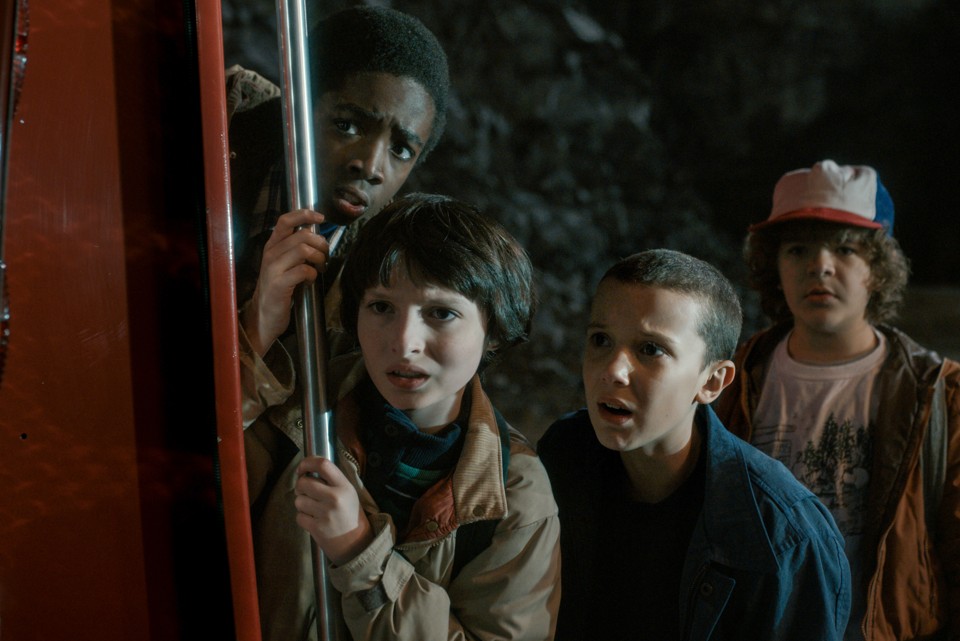
Re-watch the following clips before looking at the example question and answer:
People have been asking me for an example of how to use the C.E.E.A structure to answer Question 1 so here is an example of a question 1 and how you would use the structure to address EACH of the bullet points:
(Please note that this is AN EXAMPLE. You will not know the real three bullet points until you encounter the questions in the actual exam)
Please also note how I am writing IN ROLE which the exam requires you to do at all times, even for question 1.
1) We believe that Serial Television Dramas are successful because they:
- Offer a number of audience
pleasures
- Have interesting characters
- Have either narrative arcs
or episodic narratives to keep the audience interested in the whole series
Remember C.E.E.A as your structure:
C-
Convention
E- Example
E- Explanation
A-Audience pleasure / effect on audience / how it targets them
Let's take bullet point 1 and answer in a paragraph about Stranger
Things: (I have colour co-ordinated for you to see where the big marks are)
Dear AtoZ Productions,
In
the hope of achieving a potential apprenticeship with your company to make my
own serial television drama, I have been studying existing products in the
genre. I completely agree that they offer a number of different audience
pleasures to keep people watching. An example would be the Netflix
Original series, Stranger Things, where the horror and science fiction
sub-genre will appeal to an audience looking for ‘Diversion’ so they can find
escapism in the fictional town of Hawkins and the world of scientific
experiment and parallel universes offered by the show’s narrative. The show also
focuses on the adventures of a group of teenagers who are friends and one of
them goes missing. This disruption to the equilibrium means that a young audience
may be able to relate to the idea of losing a friend or bonding together to try
and sort out a problem. There are other narrative strands, such as a love triangle with Mike’s
sister and two potential boyfriends – this might be appealing for young
girls or boys in similar situations. Much of the drama is set in a small
town, in domestic homes or in a high school which is familiar to
audiences who have similar lives. Over the whole series, it is possible for the
audience to form relationships with the characters by learning their
back stories and we care about whether or not Will can be reunited with his
mother after his kidnap by the monster in the first episode.
Let's take bullet point 2 and answer in a paragraph about Stranger
Things: (I have colour co-ordinated for you to see where the big marks are)
I
also agree that TV Dramas have to have interesting characters to attract and
keep their audience. Normally, it is conventional for a TV Drama to have an ‘ensemble
cast’ where there is not one main protagonist (hero) but instead many
characters so that we can learn about their own narratives. In Stranger Things,
the narrative focuses on a group of friends of ‘stock characters’ that fit
stereotypes the audience can recognise: the funny one (Dustin), the cynical one
(Lucas), the leader who makes the decisions (Mike) and the sensitive ‘innocent’
Will who is kidnapped. Audiences will also enjoy watching the anti-hero Hopper who is a town Sheriff
with a sad past as his daughter has died and he is a subversive
policeman as he drinks, swears, smokes and punches people rather than following
the law and arresting them. Will’s mother Joyce and his brother Jonathan are
also key characters in the ensemble cast because we see how their lives have
been torn apart by the loss of Will and how they deal with getting him back by
taking on the monsters and the evil villain scientist. Stock characters
and more subversive characters mean the audience can relate to the characters
and identify them as ‘types’. Eleven is an interesting character as she is
subversive for a female hero – she is a young girl who wears a dress but has a
shaved head because she was experimented on in a laboratory. She also has super
powers and can manipulate things with her mind which is exciting for the viewers as
they do not know if she will be captured or use her powers for good or evil.
Let's take bullet point 3 and answer in a paragraph about Stranger
Things: (I have colour co-ordinated for you to see where the big marks are)
Most
Serial TV Dramas have episodic narratives, where stories are resolved in one
episode, so that the ‘casual viewer’ can be rewarded. They also feature ‘story
arcs’ where a narrative is on-going throughout all the episodes so that loyal
viewers who always tune in can be rewarded for their loyalty. In Stranger Things,
the on-going narrative arc is the kidnap of Will and the enigma codes that are
posed to the audience: Will he survive or die? Will he be rescued from the
Upside Down? Will his mum or his friends be the ones to save him? This on-going
tension causes viewers to want to watch the next episode after the opening
where they are ‘hooked’ in by the disappearance of Will within the first 8
minutes. This dramatic disruption to the equilibrium is not resolved until the
last episode so the tension builds and there are lots of cliff-hangers at the
end of each episode so that audiences are encouraged to ‘binge watch’ the whole
series, which was released all at once. There are also episodic storylines
focusing on individual characters, such as flashbacks to Eleven’s sad
childhood; the back story where Hopper’s daughter dies of cancer, and the ‘happier
times’ memories that Will’s mother has of their time together. Also, Nancy and
Steve’s relationship and the death of Barb (Nancy’s friend) are dramatic
narratives that develop within an episode and keep the audience watching as
they are given some resolution as the story progresses.
Try answering some of your own C.E.E.A paragraphs using examples from our other case studies: Waterloo Road and Doctor Who.
Last tip - remember that you MUST talk about at least 2 TV Dramas from our case studies so if you wrote the above answers JUST using Stranger Things, you would limit your marks. Make sure that you are able to say detailed examples from more than one television drama across the three bullet points.
Good luck!
Miss Fowler
Subscribe to:
Posts (Atom)